 Account
Support for the moment you are actually in
You do not have to think your way out of every feeling.
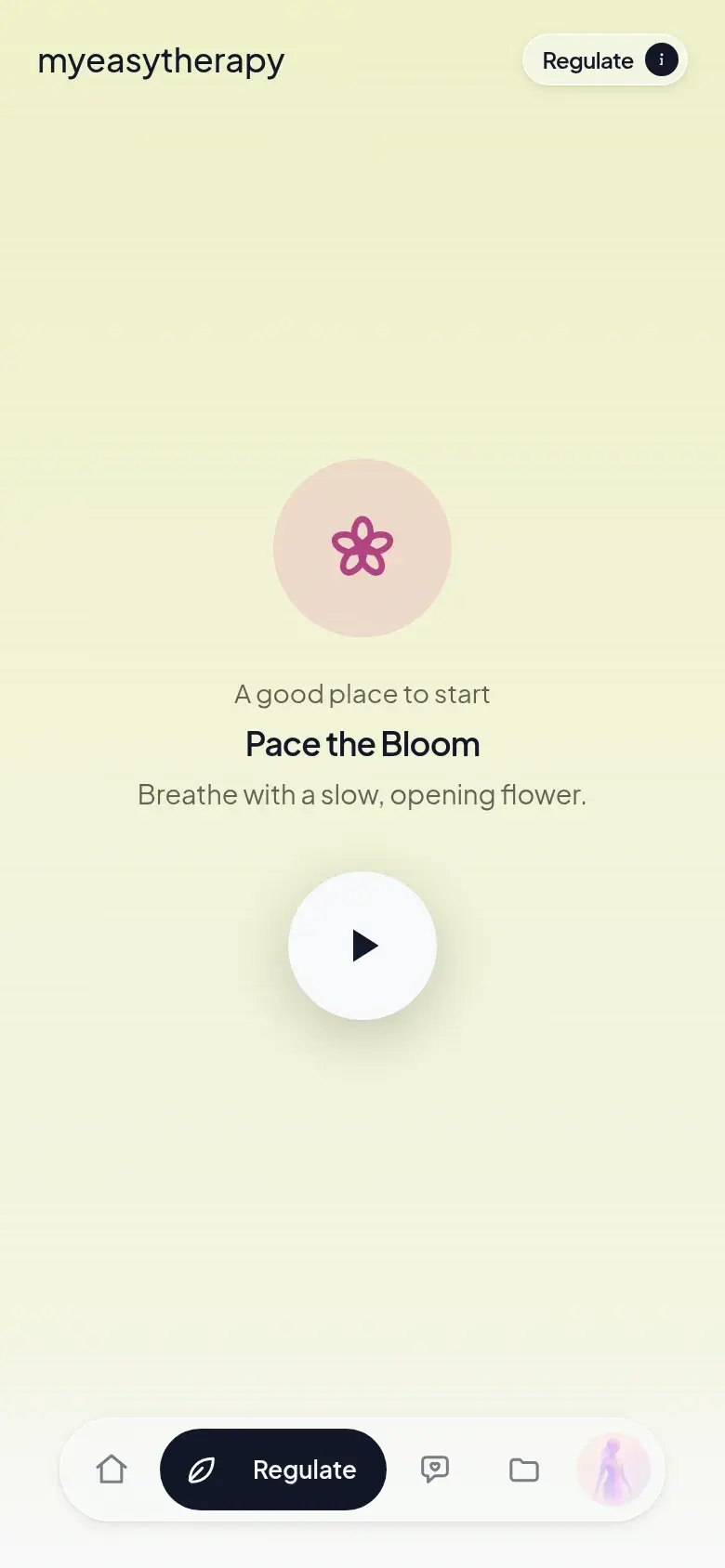
Regulate helps you slow the reaction, understand what your nervous system needs and follow a guided exercise suited to your current state.
It gives you something practical to do when insight alone is not enough.
Knowing why you feel something does not always change how it feels.
You may understand that you are overwhelmed and still feel unable to settle. You may recognise a reaction as disproportionate and still feel pulled towards it.
You may tell yourself to calm down, stop overthinking or let it go, while your body carries on as though something urgent is happening.
Regulation begins beneath that argument. It works with the state of your body so that clearer thinking becomes available again.
A guided route from activation to choice.
Regulate is a library of guided regulation exercises organised around how you actually feel, not what technique you think you should use.
You start from one of six states (your body feels anxious, you cannot stop thinking, you feel overwhelmed, you feel tense or irritated, you cannot sleep, or you need a deeper reset) and are taken to a matching guided track.
Exercises include breathing practices, somatic and grounding work, guided audio and visual breath pacing.
- Six starting points, named the way you actually feel
- Breathing, grounding, somatic and guided audio exercises
- Your check-in sets the need; your profile tips the choice
- Stop, skip or change anything at any point
Step by step
How it works
Step 1 of 4
What it gives you
What regulation gives back to you
Space between feeling and action
Enough room to choose your next response rather than react.
Access to clearer thinking
Support the body first, so analysis and problem-solving become useful again.
Less emotional accumulation
Address activation earlier instead of carrying it through the rest of the day.
More confident boundaries
Communicate clearly without collapsing, exploding or over-explaining.
Greater emotional range
The aim is not suppression. It is the capacity to feel deeply without being controlled by every feeling.
Use Regulate when the moment needs support.
Daily Calm builds a regular practice. Regulate is for the moments when you are already activated, overwhelmed or shut down.
Iris can then help you explore what happened, understand the pattern and decide what you want to do about it.
You stay in control of the experience.
You can stop, skip or change any exercise at any point. Regulation practices land differently for different people, so choose what feels accessible to you.
My Easy Therapy is not an emergency or crisis service. If you need urgent help, contact your GP, local emergency services or a crisis line.
What Regulate can’t do
- Regulate offers short guided exercises for difficult moments. It is not crisis support: if you are in danger or cannot keep yourself safe, contact your local emergency number.
- Stop any exercise that leaves you light-headed, more distressed or uncomfortable, and breathe normally.
My Easy Therapy is emotional wellbeing support, not therapy. It does not diagnose or treat any condition and is not a substitute for professional care.
Questions
Before you start
What does emotional regulation mean?
The ability to recognise, experience and respond to emotions without automatically being controlled by them.
Does regulation mean calming down?
Not always. Calm may be useful, but regulation can also help you become more grounded, expressive, boundaried or ready to act.
How do I know which exercise to use?
You choose the state that fits (your body feels anxious, you cannot stop thinking, you feel overwhelmed, you feel tense or irritated, you cannot sleep, or you need a deeper reset) and Regulate leads you to a matching exercise.
Can I use Regulate during intense emotions?
Yes, it is designed for emotionally difficult moments. It is not, however, emergency or crisis support.
What do I actually get inside the app?
Daily Calm, a short guided session each day written by Dr Michaela; Regulate for in-the-moment support; Iris, an AI-supported companion for working things through; gentle daily check-ins that grow Your Garden; and your Neuro-Sensitivity Profile. Five parts, one loop across your day.
What is Iris?
Iris is the private, AI-supported companion inside the app, for validation, practical skills and ongoing conversation that fits your daily rhythm. Iris is not a therapist or a crisis service. (Iris also answers the questions on this page.)
Go deeper
More on Regulate
Create space before the moment decides for you.
Guided tools designed to help you return to choice.
Before you go
You are not broken.
You’re overloaded, over-responsible and under-supported. Build emotional skills that match the size of your life.
Join My Easy Therapy →