 Account
Understand your patterns without reducing yourself to a label
Discover how your system experiences the world.
The Neuro-Sensitivity Profile™ helps you understand how you process stimulation, emotion, pressure and connection.
It turns patterns that may have felt confusing into a practical map for looking after yourself.
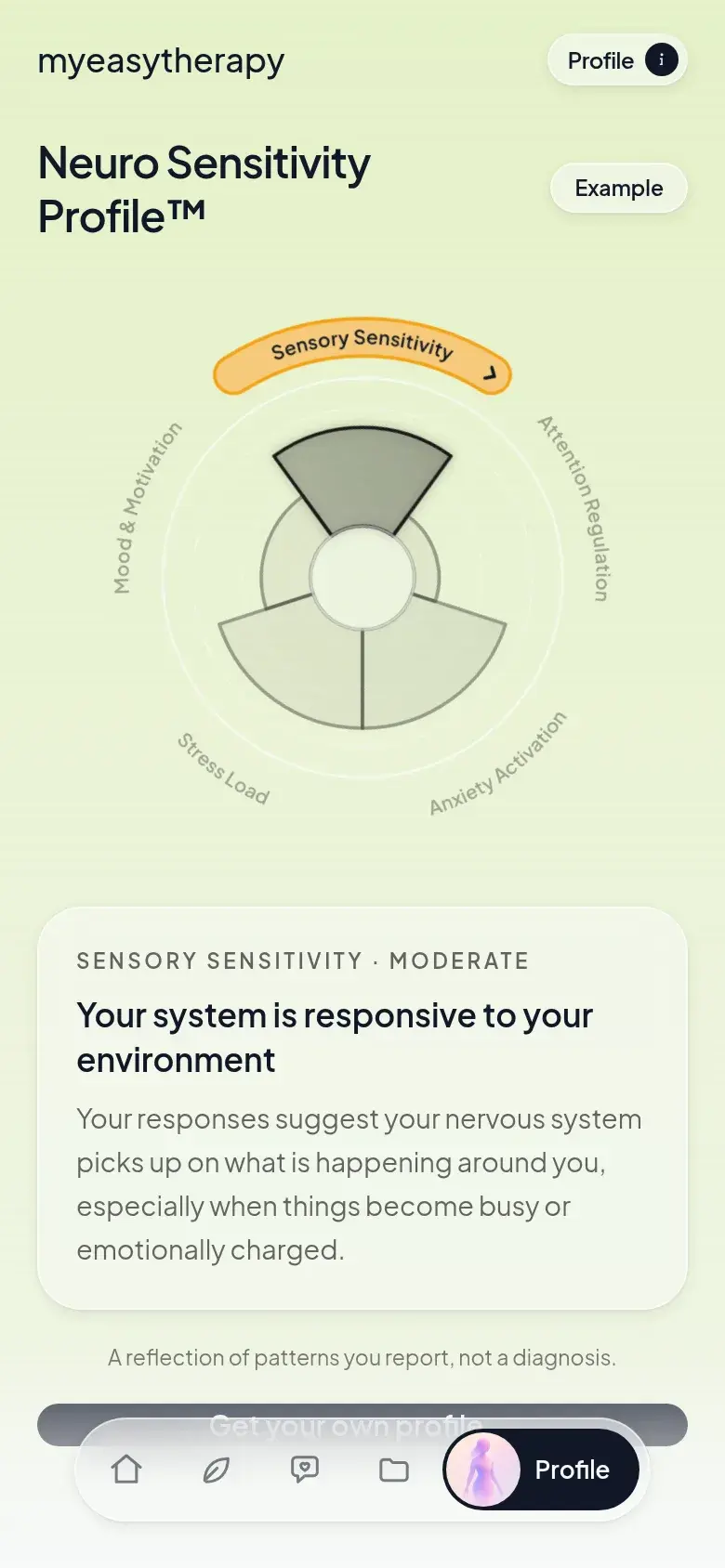
You may have spent years judging patterns you were never taught to understand.
You may become overstimulated faster than the people around you. You may notice small changes in tone, atmosphere or behaviour. You may think about an experience long after it ended.
You may feel things intensely while looking entirely capable from the outside, and need more recovery after socially or emotionally demanding days.
Without a useful framework, those patterns get read as weakness, overreaction or personal failure. The profile offers another option: understand the pattern first, then decide how to work with it.
A personalised map of your sensitivity patterns.
The Neuro-Sensitivity Profile™ is a guided questionnaire of 46 questions across five areas: sensory, stress, anxiety, mood and attention.
Your answers become a visual profile showing how those areas relate to one another, with an explanation of what each area means in everyday life.
Alongside it, a Rhythm view connects your broader profile with your recent check-ins, because how your system tends to work and what is happening for you lately are two different things.
- 46 questions across five areas
- A visual profile you can explore area by area
- A Rhythm view drawn from your recent check-ins
- Informs Iris and your regulation suggestions
Step by step
How it works
Step 1 of 4
What it gives you
Understanding changes the quality of your choices
What drains you
Identify the environments and expectations that place a disproportionate load on your system.
What restores you
Understand the kinds of space, movement, input and connection that actually help you recover.
Where strengths become strain
Deep thinking can become rumination. Empathy can become over-responsibility. Attention to detail can become perfectionism.
Which boundaries matter
Make more intentional decisions about access, stimulation, recovery and emotional labour.
How to regulate more effectively
Your profile helps choose strategies that suit you, rather than assuming one technique fits everyone.
Insight that changes the support you receive.
This is the difference between a personality quiz and an integrated profile: your results do not sit in a results page and stop.
Your profile informs the questions Iris asks you, and helps decide which regulation exercise is offered when you are struggling, always secondary to how you are right now.
A map should create freedom, not confinement.
This is a reflective wellbeing profile. It is not a medical, psychiatric or psychological diagnosis, and it is not a validated clinical instrument.
Context affects behaviour, profiles hold complexity, and no score should be treated as a fixed identity. It is a starting point for reflection, not a verdict on who you are.
What Neuro-Sensitivity Profile can’t do
- The profile is a reflective questionnaire, not a diagnostic or validated psychometric test. It cannot tell you whether you have ADHD, anxiety or any other condition.
- Your answers describe tendencies at a point in time, and they can change.
My Easy Therapy is emotional wellbeing support, not therapy. It does not diagnose or treat any condition and is not a substitute for professional care.
Questions
Before you start
Is the Neuro-Sensitivity Profile™ a diagnosis?
No. It is a reflective wellbeing profile and should not be used as a medical, psychiatric or psychological diagnosis.
How long does it take?
It is 46 questions across five areas. You can pause partway and pick it back up. Your progress is saved.
Is this the same as a Highly Sensitive Person test?
No. It is our own reflective questionnaire and is not equivalent to the Highly Sensitive Person Scale or any published clinical or academic instrument.
What is the difference between Profile and Rhythm?
Profile is how your system tends to operate. Rhythm reflects what has been happening more recently, drawn from your check-ins. A naturally sensitive system and an unusually demanding month are different things.
How does the app use my profile?
It informs the questions Iris asks and helps choose which regulation exercise is offered, always after your current check-in, so immediate needs come first.
What do I actually get inside the app?
Daily Calm, a short guided session each day written by Dr Michaela; Regulate for in-the-moment support; Iris, an AI-supported companion for working things through; gentle daily check-ins that grow Your Garden; and your Neuro-Sensitivity Profile. Five parts, one loop across your day.
Go deeper
More on Your Neuro-Sensitivity Profile™
Stop judging your patterns. Start understanding them.
Discover the conditions that help you feel, think and lead with more clarity.
Before you go
You are not broken.
You’re overloaded, over-responsible and under-supported. Build emotional skills that match the size of your life.
Join My Easy Therapy →